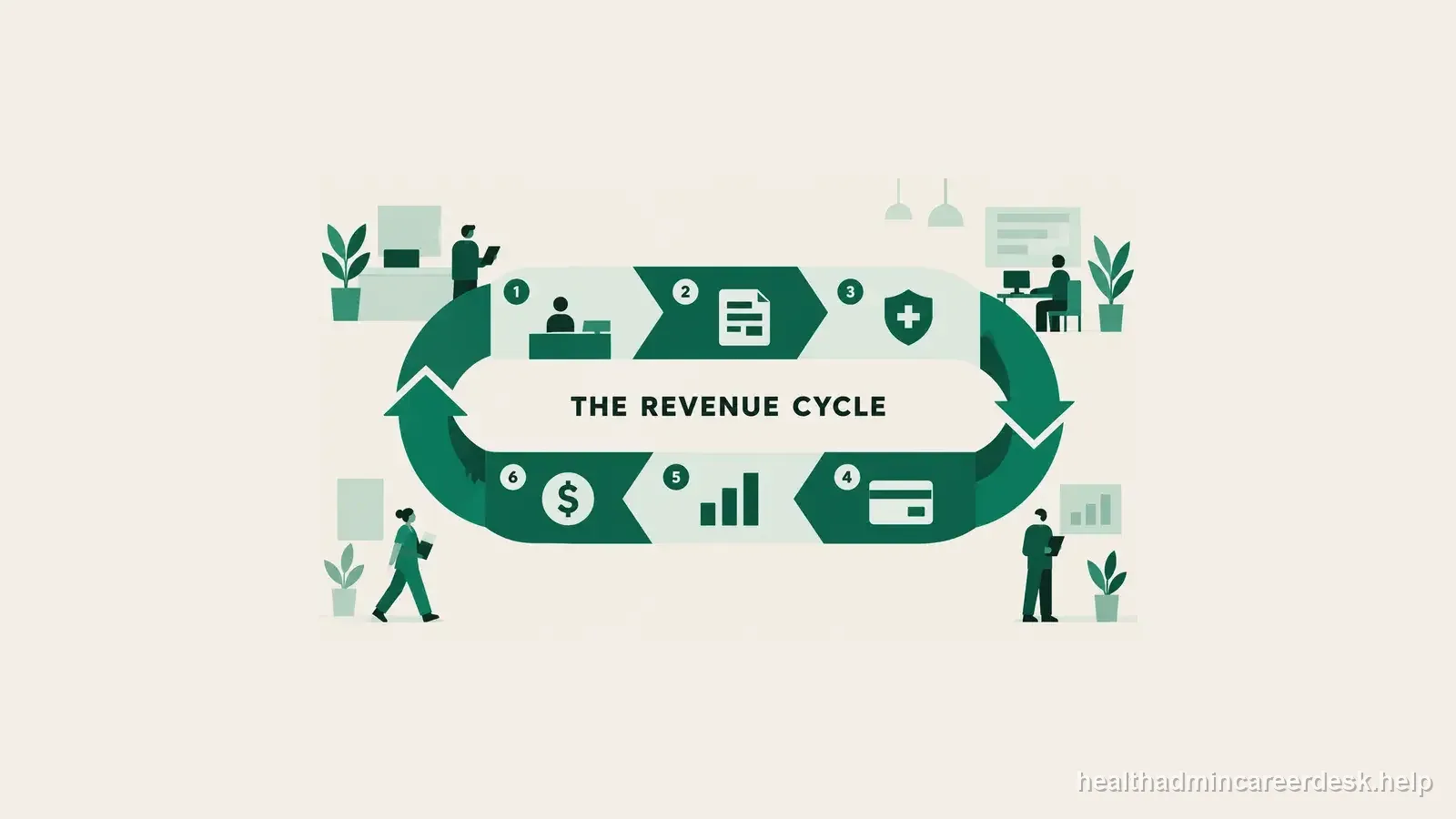
The revenue cycle is the path from a patient deciding to receive care to the organization reconciling the final payer and patient balances. It is often drawn as a neat circle, but the real work behaves more like a chain of handoffs. A registration error can create a claim rejection days later; a missing authorization can become a denial after the service; a payment-posting error can create a false patient statement. Understanding the sequence lets a new biller investigate upstream instead of repeatedly treating the final symptom.
The 11 handoffs
- 1. Scheduling and service planning
- 2. Eligibility and benefits verification
- 3. Registration and insurance capture
- 4. Authorization/referral work where required
- 5. Charge capture and documentation completion
- 6. Coding and claim preparation
- 7. Claim edits and clearinghouse transmission
- 8. Payer adjudication
- 9. ERA/EOB receipt and payment posting
- 10. Denial, underpayment, and A/R follow-up
- 11. Correct patient balance, statement, payment, or approved collections path
Front-end revenue cycle determines what billing inherits
Eligibility does not guarantee payment, but it tells the team whether coverage is active and can reveal benefit, coordination-of-benefits, or authorization issues before service. Registration captures the subscriber and provider data that will become claim fields. Prior authorization, when required, must be obtained under the correct payer and plan process. If those steps are skipped, the biller may receive a technically well-coded claim that still fails. Good organizations therefore measure front-end defects and send them back to the process owner instead of asking the billing team to fix every problem after adjudication.
Mid-cycle turns the clinical encounter into a transaction
After care is delivered, documentation supports charge capture and coding. The professional claim may be represented on the CMS-1500 form conceptually but transmitted electronically as an 837P. A clearinghouse can run edits before routing it to the payer. A rejection here means the transaction has not completed normal payer adjudication; the team should correct the data defect and retransmit. This is why “clean claim rate” needs a definition. A claim can pass front-end edits and still be denied later for coverage, authorization, coding, or other reasons.
Where common KPIs point
| Metric | What it can reveal | What it does not prove |
|---|---|---|
| Clean-claim / first-pass acceptance | front-end data and edit quality | that payer will pay the claim |
| Denial rate | frequency of adverse adjudication | root cause without categorization |
| Days in A/R | speed of unresolved receivables | whether every old balance is collectible |
| Authorization denial rate | front-end authorization defects | that all denials belong to authorization team |
| Patient A/R | unresolved patient responsibility | that statements were correct |
Adjudication changes the evidence set
Once a payer processes the claim, the ERA or EOB becomes central evidence. CMS explains that remittances report adjustment information using group codes, CARCs, and RARCs. Those codes help determine whether the unpaid amount is contractual, patient responsibility, or an issue requiring follow-up. Posting should preserve that meaning. If a contractual adjustment is moved to the patient, the organization creates a new billing error after the payer has already finished its work.
A/R is not the final step; feedback is
A mature cycle sends root-cause information upstream. Timely-filing denials can reveal delayed charge capture. Eligibility denials can point to weak registration controls. Modifier or coding edits may point to coding education or documentation issues. Patient complaints can reveal posting or estimate problems. Use the feedback to reduce avoidable touches on the next account rather than assigning blame to another department. For a beginner, this is the difference between knowing the eleven steps and understanding why they are connected.
How to learn the cycle on a first job
Draw the path of one real de-identified account from appointment to zero balance. Record which team owns each transition, which system object carries the data, and which report catches exceptions. Then choose one denial and trace it backward to the first point where the eventual problem became detectable. This exercise teaches far more than memorizing a circular infographic because it reveals the organization’s actual handoffs and controls.
- Follow a de-identified account from appointment to balanceRecord the team, system object, and exception report at each handoff.
- Select one denial or rejectionCollect the evidence that explains the downstream result.
- Find where the problem first became detectableTrace the data or process back to its source.
- Name the upstream owner and controlUse the finding to prevent a repeat on a future account.
A revenue-cycle map is useful only if every handoff has an owner
The 11 steps are not eleven departments in every organization. In a small clinic, one person may schedule, verify coverage, collect registration data, and request authorization; another may code and submit; a third may post payments and work A/R. In a hospital or large RCM operation, each step may have its own team and queue. The learning goal is to understand what information must survive the handoff. Eligibility needs the correct patient-plan pair; charge capture needs the actual performed service; coding needs complete documentation; claim submission needs valid provider and payer data; remittance posting needs the adjudication detail; patient billing needs the payer responsibility to be settled correctly.
Metrics should be used to locate a failure, not to decorate a dashboard. A worsening denial rate can be caused by authorization, coding, eligibility, enrollment, or payer-policy changes. Days in A/R can rise even when claims are clean if a payer slows adjudication or a team stops following pending accounts. Clean-claim rate can improve while underpayments go unnoticed. A first-job employee who learns to ask “which upstream step created this downstream result?” is learning revenue-cycle management rather than merely processing a queue.