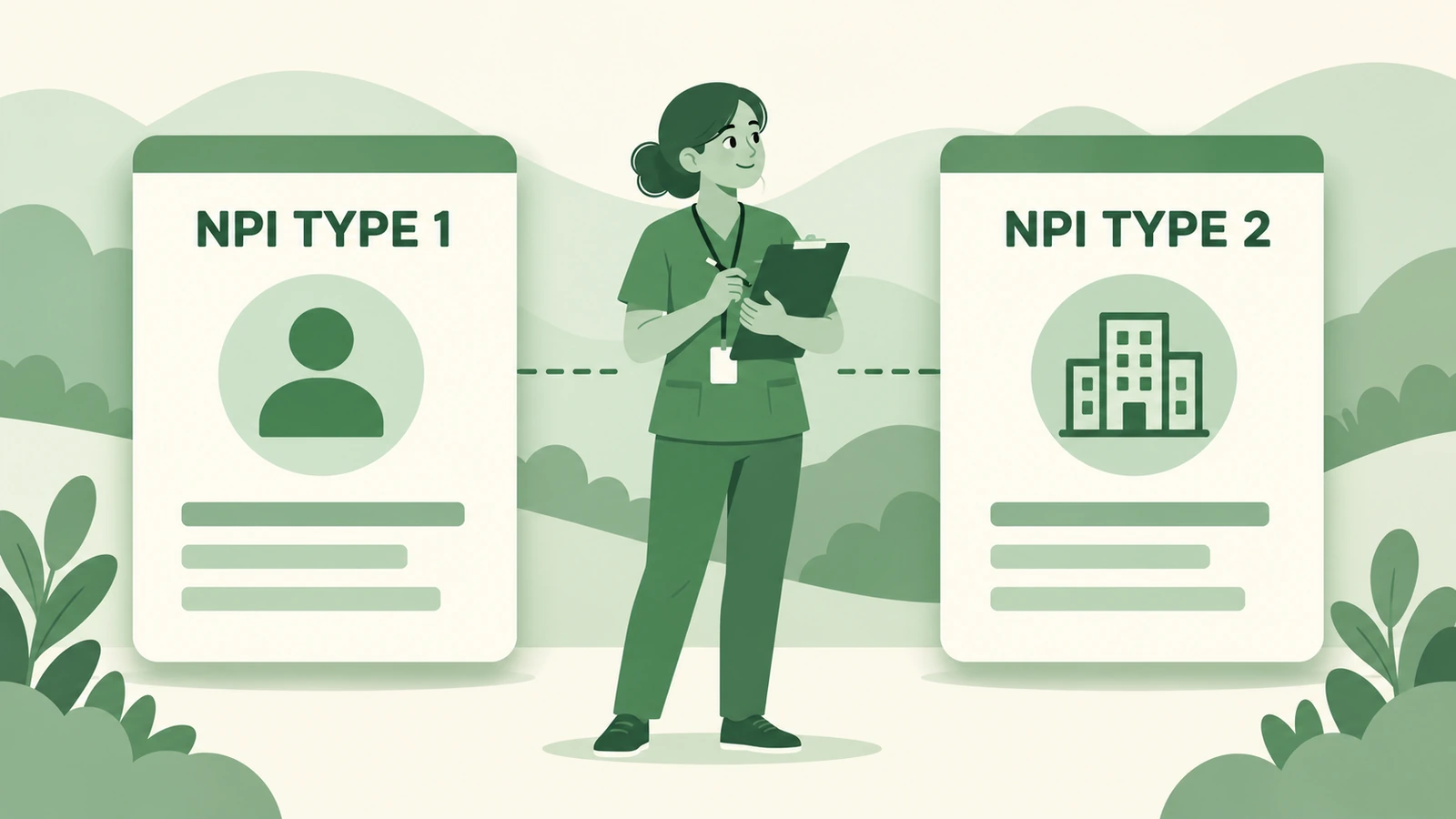
Confusing Type 1 and Type 2 NPI numbers is one of the more common credentialing mistakes, and it's an easy one to make because both are simply 10-digit numbers with no visible label distinguishing which type they are — the difference is entirely about what the number identifies, not how it looks.
What each type actually identifies
A Type 1 NPI identifies an individual person — a physician, nurse practitioner, therapist, or any other individual practitioner. A Type 2 NPI identifies an organization: a clinic, group practice, hospital, or supplier as a legal business entity. An individual is enumerated once and keeps that same Type 1 number for their entire career, even through name changes, employer changes, or moves between states — it is not reissued or changed to reflect a new job.
Who is actually required to get each type
Every individual provider who bills or refers under their own name is required to obtain a Type 1 NPI. Organizations — practices, facilities, suppliers — must obtain a Type 2 NPI as a legal entity. A provider who has incorporated their practice, even as a single-member LLC or professional corporation, typically needs both: a Type 1 for themselves personally, and a Type 2 for the business entity that actually bills and receives payment.
Where each number actually goes on a claim
On a typical professional claim, the Type 1 NPI identifies the rendering provider — the specific individual who actually performed the service — while the Type 2 NPI identifies the billing provider, the organization that submits the claim and receives payment. Putting a Type 2 number in the rendering-provider field, or vice versa, is a common source of claim rejections or delayed payment that has nothing to do with medical necessity or coding accuracy.
Type 1 vs. Type 2 at a glance
| Type 1 | Type 2 | |
|---|---|---|
| Identifies | An individual person | An organization or legal entity |
| Held for life? | Yes, one per person, unchanged across jobs | No, tied to the specific entity |
| Can hold more than one? | No, only one Type 1 ever | Yes, an organization can hold multiple Type 2 NPIs (subparts) |
| Typical claim field | Rendering provider | Billing provider / pay-to organization |
Why an organization might hold more than one Type 2 NPI
A single legal organization can enumerate multiple Type 2 NPIs for distinct subparts — for example, separate locations or separate service lines that need to be identified independently for billing, reporting, or contracting purposes. This is a deliberate design choice in the NPI system, not an error; a large health system's central Type 2 NPI and its individual clinic-level Type 2 NPIs can coexist for exactly this reason.
What happens during the actual NPI application
Applying through the National Plan and Provider Enumeration System (NPPES) requires selecting the entity type — Type 1 (Individual) or Type 2 (Organization) — as one of the very first steps, and that choice determines the rest of the application's required fields. An individual application asks for the person's own credentials and taxonomy; an organization application asks for the legal business name, an authorized official, and the organization's own taxonomy, which is a meaningfully different data set from an individual application.
Why credentialing staff specifically need to get this right
Payer enrollment applications (Medicare's 855I for individuals, 855B for organizations/group practices, for example) reference the NPI type appropriate to that specific form — submitting an 855B group enrollment application referencing a Type 1 number where a Type 2 is expected, or vice versa, is a common cause of enrollment application rejection or processing delay that has nothing to do with the actual credentials or qualifications being reviewed.
Keeping NPI records accurate as a provider's situation changes
A provider's Type 1 NPI itself never changes, but the information associated with it in NPPES — practice address, taxonomy code, contact information — does need to be kept current, and a mismatch between what NPPES shows and what a payer's own enrollment record shows for the same NPI is a routine source of claim denials unrelated to the service itself. When a provider changes practices, joins a new group, or adds a new specialty, update both the NPPES record and every payer enrollment tied to that NPI — updating one without the other leaves a mismatch that surfaces later as an unexplained denial.
It's worth checking your own organization's provider roster periodically against NPPES directly, since a Type 1 NPI that's been inactive at your organization for months (a provider who left, or one on extended leave) sitting in an active enrollment record can itself trigger unnecessary payer scrutiny — keeping the roster synchronized between your internal system, NPPES, and each payer's own enrollment record is a small recurring task that prevents a larger reconciliation problem later.
One more distinction worth remembering: an Employer Identification Number (EIN) and a Type 2 NPI are not the same thing and are not interchangeable on enrollment paperwork, even though both identify a business entity. The EIN is a tax identifier issued by the IRS; the Type 2 NPI is a healthcare-specific identifier issued by NPPES, and most payer enrollment forms require both, in their own separate fields, rather than accepting one as a substitute for the other.
Keep both numbers documented together in your credentialing tracking system for every provider and every billing entity, cross-referenced clearly, so a new hire on the billing or credentialing team can immediately see which number is which without having to look each one up separately in NPPES during a claim rejection investigation.