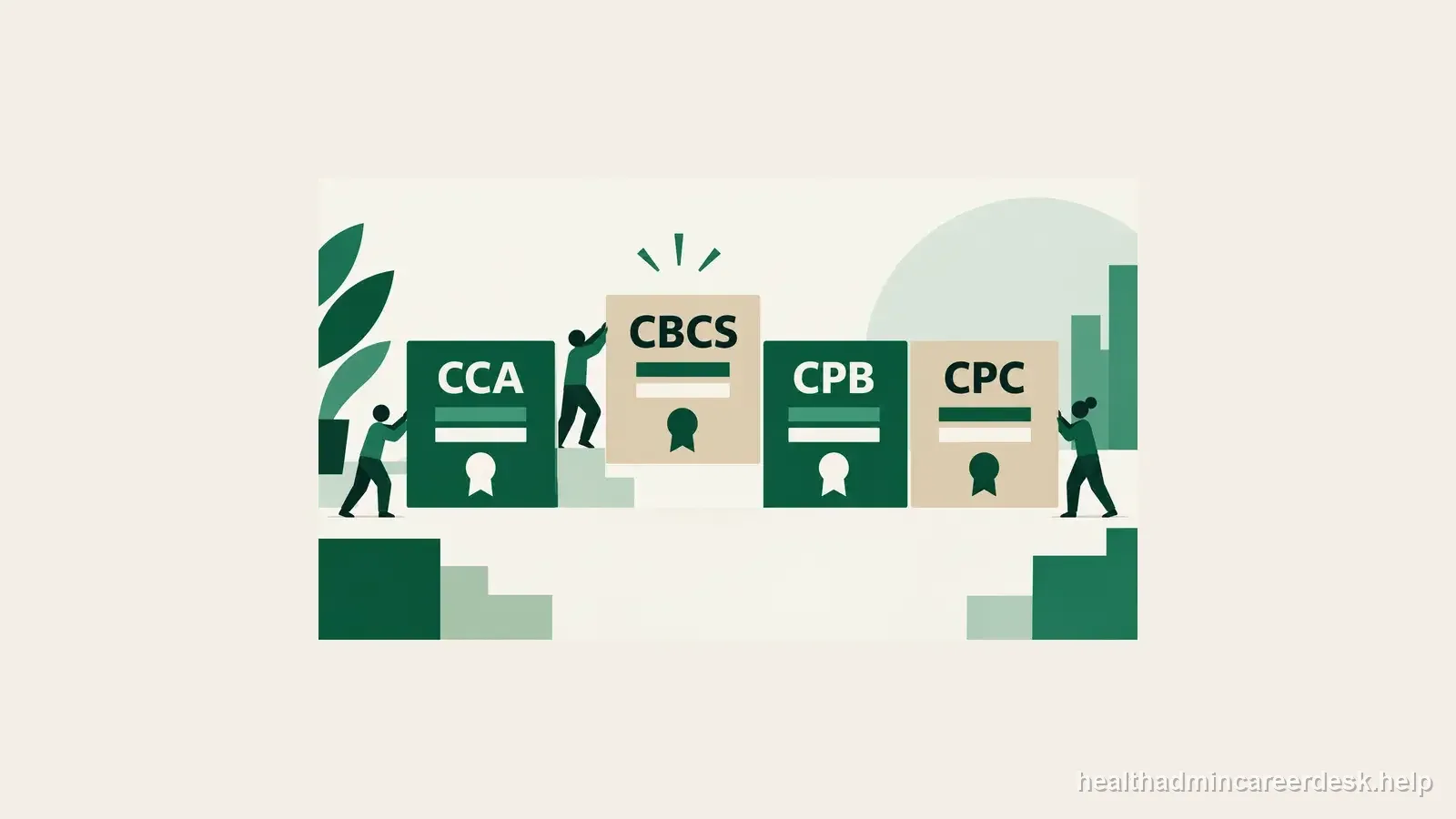
CCA, CBCS, CPB, and CPC are not interchangeable certificates with different logos. They test different mixes of coding, reimbursement, and healthcare administration. Start with the job you want. If your target is physician-office coding, CPC is highly relevant. If you want a broad early-career coding credential through AHIMA, CCA is designed for that stage. If you want billing and reimbursement, AAPC’s CPB is built around the claim life cycle and payer work. NHA’s CBCS intentionally combines billing and coding knowledge for entry-level billing-and-coding roles. Choosing first by job target prevents a common mistake: buying the exam attached to a training package before checking whether nearby employers ask for it.
Current first-credential comparison
| Credential | Issuer | Primary emphasis | Current fact to verify before registering |
|---|---|---|---|
| CCA | AHIMA | Early-career coding / health information | High school diploma required; 2026 codebooks required for exams on/after May 1, 2026 |
| CBCS | NHA | Entry billing + coding | Training within last 5 years OR qualifying supervised work experience; renew every 2 years |
| CPB | AAPC | Professional billing and reimbursement | 135 questions in 4 hours; current CPC/CPB exam page lists approved code books |
| CPC | AAPC | Professional physician coding | 100 multiple-choice questions in 4 hours; 17 knowledge areas and 10 cases |
CCA: broad early-career coding foundation
AHIMA positions the Certified Coding Associate as an early-career credential. The current eligibility page says candidates must have a high school diploma. AHIMA recommends, but does not universally require, coding experience or formal training that covers anatomy and physiology, terminology, and basic ICD/CPT work. The current exam has 105 total questions, including scored and pretest items, and two hours of testing time. For exams delivered on or after May 1, 2026, AHIMA requires the 2026 codebooks listed by the organization. CCA can make sense for someone pursuing a coding/HIM path who is not yet ready for the experience level associated with CCS.
CPC: strong signal for professional coding
AAPC’s CPC is centered on coding physician and professional services using CPT, ICD-10-CM, and HCPCS Level II. AAPC currently lists 100 multiple-choice questions and four hours, with 17 areas of knowledge and ten cases at the end of the exam. Passing without the experience requirement results in the CPC-A apprentice designation until approved experience/education pathways are completed. CPC is a logical choice when the job postings you want consistently ask for professional-fee coding and CPC is the credential named by those employers.
CPB: the billing lane is not a lesser coding lane
The Certified Professional Biller exam is built around billing and reimbursement rather than treating billing as a small chapter of coding. AAPC’s current page lists 135 questions in four hours and topics such as insurance plans, LCDs/NCDs, claim life cycle, denial resolution, regulations, and coding knowledge used by billers. It includes case-based policy interpretation. If your desired work is claim submission, remittance, denials, A/R, and reimbursement operations, CPB may be more directly aligned than buying a coding credential simply because it is better known.
CBCS: deliberately mixed entry-level coverage
NHA’s CBCS is designed for billing-and-coding specialist work and currently requires either recent qualifying training or qualifying supervised work experience along with high-school-level eligibility. NHA’s public material says the exam gives substantial weight to both coding and billing/reimbursement. The current NHA site also states that CBCS certification renews every two years with continuing education requirements. This credential can fit mixed office roles, but employer recognition varies by market, so verify real postings instead of assuming “covers both” means “preferred everywhere.”
Do not freeze fees, retake rules, or allowed books from a blog
Exam prices, delivery options, allowed reference books, eligibility details, and recertification rules can change. Check the certifier’s live page on the day you register and save the page or candidate guide that governed your purchase. This is especially important in 2026 because AHIMA changed required codebook years for CCA/CCS exams beginning May 1, and NHA has changed CBCS testing logistics over time. A certification guide should help you choose the lane; the certifier should control the final administrative facts.
A useful decision order
First choose the job family: coding, billing/reimbursement, or a mixed entry office role. Second inspect real employer preference in your market. Third check whether you meet current eligibility and can afford the full cost, including codebooks or training if required. Fourth compare the apprenticeship or recertification burden after the exam. Only then choose the credential. That order is less exciting than a “best certification” ranking, but it produces a decision tied to the work you actually want.
The current exam facts make one common comparison misleading
AHIMA’s current CCA page lists a high-school diploma as the eligibility requirement, 105 total questions, two hours, a passing score of 300, and 2026 codebooks for exams delivered on or after May 1, 2026. AAPC’s current CPC page lists 100 questions in four hours and a 70% passing score (at least 70 of 100 questions correct). Those are not minor format differences: they change how you prepare and what kind of practice you need. For CBCS and CPB, use the live NHA and AAPC pages when you are ready to register because eligibility, fees, delivery options, and maintenance rules can change.
Certification comparison pages often collapse the decision into “CPC = best recognized” or “CBCS = cheapest.” A better decision includes the employer setting. If your target postings are physician-office coding jobs that repeatedly name CPC, saving on a different exam may not solve your hiring problem. If your target is billing/claims rather than code assignment, a billing-focused credential and strong revenue-cycle practice may fit better. If you are aiming at hospital coding, the CCA-to-CCS path can make more sense than treating every entry credential as interchangeable.
| CCA (AHIMA) | CPC (AAPC) | |
|---|---|---|
| Eligibility | A high school diploma | Passing without the experience requirement results in the CPC-A designation |
| Questions | 105 total, including scored and pretest items | 100 multiple choice, with ten cases at the end |
| Time | Two hours | Four hours |
| Passing score | 300 | 70% (at least 70 of 100 correct) |
| Books | 2026 codebooks for exams delivered on or after May 1, 2026 | Approved CPT, ICD-10-CM, and HCPCS Level II books |
Check the live certifier pages when you register. Fees, books, and eligibility can change.